Thursday, 1 February 2018

First Android 9.0 Developer preview is almost Finalized! Is it coming Soon?


Hello
The first developer preview of Android P is close to being finalized, as suggested by a newly discovered commit found in the main repository of the Android Open Source Project which contains what appears to be a relatively straightforward message: “The future is now (2018 edition).” The line initially spotted by Mishaal Rahman of XDA Developers doesn’t elaborate on the matter, with the commit it’s attached to last being updated on Tuesday.
As is usually the case in the run-up to the release of the first experimental build of a major Android revision, Google has been tight-lipped about the affair and provided little to no info in regards to what developers and consumers can expect from the next iteration of its ubiquitous mobile operating system that’s been running on over two billion of monthly active devices as of mid-2017.
A number of previously spotted references to Android P suggested Google may be looking to expand on its Android Things platform, specifically in regards to its integration with other solutions from the company such as Chromecast.

The Go Edition of the OS that debuted with the first stable variant of Android 8.0 Oreo should also be improved with the next software upgrade and the tech giant is expected to deepen its support for Project Treble, an internal effort to restructure Android as a whole in order to facilitate the process of creating minor firmware updates for eligible devices. While original equipment manufacturers who launch devices with Android Nougat and upgrade them to Oreo aren’t required to support Project Treble.


The system will be mandatory for every device maker looking to make a device running Android P, regardless of whether its product launches with the upcoming OS build or not. Some previously discovered AOSP commits also suggested that the 2018 edition of Android will be identified by the version number 9.0 which would be in line with Google‘s recent practices that haven’t seen a major OS upgrade without an accompanying integer change in its version number since the 4.4 KitKat build launched in late 2013.
This year's iteration of the Google I/O developer conference should at least partially be dedicated to Android P and may see the debut of its second developer preview, as was the case with Oreo last year. If the new OS follows a similar development pattern to its predecessor, its initial experimental build may be launched as early as March. The Alphabet-owned company isn’t expected to announce the release date of Android P Developer Preview 1 in advance and should instead just make its system images available with no previous teasers in the coming months.

What would be your feeling if your Phone gets Android P??

Wednesday, 31 January 2018

Xiaomi To Announce New Camera-Based Product On February 1


It seems like Xiaomi is planning to announce a camera-based product on February 1. The company has released a new teaser image via its Weibo (Chinese social media) page, suggesting that a new camera product is on the way. This will be the company’s 153rd crowd-funded product, and based on what was mentioned in the teaser itself, we’re looking at some sort of a camera, or at least image-focused gadget here, read on.

In the teaser, Xiaomi mentions a ‘human eye’ and ‘120 frames per second’, though keep in mind this is a rough translation. Xiaomi’s Weibo post also contains words ‘AR’ and ‘photos’, though that’s not all. The very same teaser image that popped up on Xiaomi’s Weibo page, also surfaced on Shanghai Hantu Technology’s (XPRINT) Weibo page, which is a very well-known company in China, and it specializes in VR tech. In addition to sharing the teaser image, XPRINT also mentioned the following words: AR technology, photo, mobile phone, and video. Truth be told, this is almost certainly not a smartphone we’re looking at here, so it’s almost certainly not the Xiaomi Mi2s  that was rumored to arrive as the first Snapdragon 845-powered smartphone. Chances are that this is one of the company’s Mi Home devices (as the teaser was not shared by the company’s main Weibo account), though it seems like the device will focus on photography, AR, and VR, which is a bit confusing, but it is possible it’s some sort of a smart printer, at least according to some reports.

As most of you know, Xiaomi is mainly known as a smartphone manufacturer, but this company is so much more than that, as it manufacturers a lot of different gadgets that have nothing to do with smartphones. Xiaomi actually manufactures action cameras, electric scooters, electric bikes, pens, air purifiers, and a ton of other devices that most of you have probably never heard of, as most of them never make it to international markets. In any case, the company is rumored to launch the Mi 2s in the near future, and the same can be said for the Mi 7 flagship, though do keep in mind that neither of those phones will arrive at this year’s MWC, as Xiaomi is not planning to make high-profile announcements in Barcelona.

Monday, 29 January 2018

Life changing short story. Must read!!!!


✍एक चाट वाला था। जब भी चाट खाने जाओ ऐसा लगता कि वह हमारा ही रास्ता देख रहा हो। हर विषय पर बात करने में उसे बड़ा मज़ा आता। कई बार उसे कहा कि भाई देर हो जाती है जल्दी चाट लगा दिया करो पर उसकी बात ख़त्म ही नहीं होती।

एक दिन अचानक कर्म और भाग्य पर बात शुरू हो गई।

तक़दीर और तदबीर की बात सुनमैंने सोचा कि चलो आज उसकी फ़िलासफ़ी देख ही लेते हैं। मैंने एक सवाल उछाल दिया।

मेरा सवाल था कि आदमी मेहनत से आगे बढ़ता है या भाग्य से?

और उसके जवाब से मेरे दिमाग़ के सारे जाले ही साफ़ हो गए।

कहने लगा,आपका किसी बैंक में लॉकर तो होगा?

उसकी चाभियाँ ही इस सवाल का जवाब है। हर लॉकर की दो चाभियाँ होती हैं।

एक आप के पास होती है और एक मैनेजर के पास।

आप के पास जो चाभी है वह है परिश्रम और मैनेजर के पास वाली भाग्य।

जब तक दोनों नहीं लगतीं ताला नहीं खुल सकता।

आप कर्मयोगी पुरुष हैं और मैनेजर भगवान।

अाप को अपनी चाभी भी लगाते रहना चाहिये।पता नहीं ऊपर वाला कब अपनी चाभी लगा दे। कहीं ऐसा न हो कि भगवान अपनी भाग्यवाली चाभी लगा रहा हो और हम परिश्रम वाली चाभी न लगा पायें और ताला खुलने से रह जाये ।

This is a beautiful interpretation of Karma and Bhagya.

Wednesday, 24 January 2018

Xiaomi MIUI 10 Announced


Xiaomi MIUI 10 Announced, Will Focus on AI and Machine Learning


HIGHLIGHTSMIUI 10 will focus on artificial intelligenceXiaomi wants to make MIUI an "unfinished business"Xiaomi made the announcement at an MIUI event in China
Xiaomi has announced the development of MIUI10, its upcoming firmware based on Android. Hong Feng, vice president of Xiaomi, is said to have announced the MIUI 10 at an assembly meeting in China. At the annual event, the company discusses and reveals key developments of their MIUI milestones every year. Meanwhile, Xiaomi has already started to roll out the MIUI 9.2 update for some smartphones that are on MIUI 9 already. Also, recently Xiaomi had listed the 40 smartphones that are eligible for the MIUI 9 update on Weibo.According to a report in MyDrivers, Xiaomi has said major research and development efforts of the MIUI team will now be moved from MIUI 9 to MIUI 10. Additionally, Xiaomi also shared an image of the event on Chinese micro-blogging website Weibo. It is clear from the reports, that the main focus for MIUI 10 developers will be artificial intelligence and machine learning.Last year in July, Xiaomi had launched MIUI 9, the current version of its MIUI custom Android ROM. The MIUI 9 was launched with the Xiaomi Mi 5X. Some of the new features of MIUI 9 included faster app load times, new design elements, lock screen shortcuts, split-screen feature, and more. Xiaomi claims to have optimised the system to enable faster app loading and boost performance.As we mentioned, MIUI 9.2 Global Stable Update is now rolling out for smartphones like Xiaomi Redmi 5ARedmi Y1 LiteRedmi Y1Mi Mix 2Redmi 5Redmi 5 PlusRedmi 4 PrimeMi 3Mi 4Mi Note. The MIUI 9.2 has brought several changes like Add to favorites icon adjustments, simplified design for virus scan result page, and hiding free and incompatible themes in the list of the purchased items. Additionally, Mi Mover now supports data migration restarting, which helps restore data migration on a new smartphone, even in case of interruption.Notably, there is no information from Xiaomi on the timelines for MIUI 10 coming to smartphones from the company's bandwagon

Tuesday, 23 January 2018

Reliance jio Republic Day 2018 Offers – Price Huye Kam Aur Services Hui Increase


Reliance Jio hamesha apne customers ke liye kuch khaas offers lekar aata hi rehta hai phir chahe occasion Holi ka ho ya Diwali ka. Is baar Republic day ke mauke par Reliance Jio laaya hai “Jio Republic Day 2018” offers. Ismein aapke liye sabho Jio plans par Rs. 50 kam kar diya gaye hain aur services ko 50% badha diya gaya hai.

1. 98 mein aapko 28 days ke liye unlimited voice calls, unlimited messages aur 2GB data milta hai.

2. 199 ka plan ab aapko 149 INR mein milega jismein 28 days ke liye free voice calls, unlimited free messages aur 42GB data yaani ki 1.5GB data per day milega, jabki ab tak ismein aapko 1GB hi milta tha.

3. 399 INR ki bajaay Rs. 349 ke plan mein bhi aapko upar di gayi sabhi cheezein milengi, lekin is plan ki validity 70 days ki hai.

4.  459 ka plan ab Rs. 399 mein bhi aapko free calls, messages, Jio apps aur 1.5GB data per day 84 dinon ke liye de raha hai.

5. Wahin Rs. 449 ke plan ki validity 91 days hi jismein yahi sab cheezein hongi. Jabki ye plan pehle aapko 509 INR mein 1GB per day data ke saath milta tha.

Iske baad jin plans mein aapko ab tak 1.5GB data per day milta tha, is Jio Republic Day 2018 ke mauke par un sabhi plans mein aapko ab 2GB data milega.

1. 198 mein 42GB ki jagah 56GB data 28 dinon ke liye milega.

2.  398 ke plan mein 105GB nahi balki 140GB data mil raha hai jiski validity 70 days hai.

3. 448 mein bhi aapko 84 days ke liye 2GB data per day milega.

4. 498 INR mein bhi Jio aapko 91 days tak 2GB data per day yaani ki 182GB 4G data de raha hai.


Is samay Jio hi ek aisa network service provider hai jo aapko lower price mein best plans offer kar raha hai, saath hi all over India mein Jio ka 4G network hai. Jabki other service provider abhi bahut kam cities mein 4G service de rahe hain. Aur Jio Republic Day 2018 offers ke baad to isse best service kahin nahin milegi.

Monday, 22 January 2018

Amazon Alexa app gets Voice Command support on Android

Countering Google AssistantAmazon is now bringing its Alexa voice commands to Android devices. The company is said to have started rolling out an update to its Alexa app to enable voice commands across Android devices. The new move comes a long time after a dedicated Alexa integration debuted on a handful of devices, including HTC U11Huawei Mate 9, and Motorola Moto X4.

The update, which is reported by folks at Android Police, is rolling out through Google Play and Amazon Appstore for Android in the coming days. We were not able to see it despite running the latest version. It will enable access to Alexa skills, control music playback, and send messages among others. Unlike the Alexa integration on Echo lineup, the latest update apparently doesn't enable a hands-free experience. It means it won't work simply by saying hotword "Alexa" when the app is not active on the screen.
                          

A screenshot provided by an Android Police commenter shows that the updated app comes in version 1.24.3555.0. It is said to have featured an Alexa button in the navigation bar to enable voice commands. But notably, there isn't Alexa hotword support to let you pass your voice commands just after saying "Alexa", contrary to what Google Assistant offers on Android devices through "Hey Google" and "OK Google" hotwords.


As we mentioned, we also updated to the latest Alexa app version to experience the new support. But we weren't able to find the reported Alexa button at the time of filing this story. We've reached out to Amazon for clarity and will update this space on the basis of the official response.

While the Alexa expansion is yet to reach the masses, TechCrunch reports that Amazon has plans to bring the same experience to the iOS platform as well. It is, however, not known by when can the new update will reach Apple devices.

Last week, Amazon India announced that there are as many as 12,000 Alexa skills available to its Indian users. The company added more than 1,000 skills since the launch of its Echo speaker lineup and Alexa store in the country in last October.

Friday, 19 January 2018

Paytm Cash launched. Here’s everything you should know about it


The new Paytm Cash is being rolled out and will eventually replace future cashbacks.


Paytm has announced a new feature under its Paytm Wallet service. The new feature is called as Paytm Cash and is aimed at preventing misuse of its cashback service.

The new Paytm Cash is being rolled out and will eventually replace future cash back. As per reports, it can be used anywhere where Paytm App is being used but will be non-transferable – neither to other Paytm accounts or to the bank.

As of now, all balance is being shoed under the Paytm wallet but now reports claimed that there will be a new Paytm Cash tab in the app apart from the Wallet option, said Gadgets 360. The new feature is being rolled out to both Android and iOS users.

Though Paytm has its reasons to issue a new feature, it remains to be seen how the Paytm Cash is being allowed to use. If it will turn out to be something like MobiKwik’s Supercash, then Paytm Cash will be a huge letdown.

Just recently, Paytm said that its app has crossed the 100 million download mark in Google Play store. The app has been integrated to Bhim app and Paytm Bank too. Also, Paytm is offering fixed deposit service.

Thursday, 18 January 2018

Google is calling Android 9.0 Update "Android Pi"?


2018’s big Android update will be Android 9, which will take over from Android Oreo. And Google’s already calling it Android Pi.
Around this time of year, we start to look forward to the next big Android update. Normally, there is tons of speculation over what type of dessert the update will be called. But this year it appears as if a name has already been coined by Google.


Google is already referring to the update as Android Pi internally. Whether or not this sticks for when it is officially launched remains to be seen, as there are plenty of dessert-based options at its disposal – parfait, pumpkin, pistachio, peanut, pecan.

The name Android Pi was discovered in some recent notes found inside Google documents. The name Android Pi, at least for now, is what the next update will be called. Though it could well change, as we have seen in the past – Key Lime Pie turned out to be KitKat in the end.


Personally, I believe Google will change the name at launch. Something like Pop Tart makes sense. Or maybe Pecan or Peanut, if Google decides to go the healthier route. Both have more of a ring to it than Android Pi. Plus, it’d get rid of any confusion with the microPC brand, Raspberry Pi.


Android 9 Features:
What can we expect from Android Pi (AKA Android 9)? Quite a bit as it goes. Expect to see it installed on plenty more Android phones than Oreo, thanks to the momentum of Google’s Project Treble.

There is also said to be more customisation options, improved widgets, full picture-in-picture support for every app, more feature parity, a renewed focus on tablets, and, if that wasn’t enough, the Pixel Launcher will be made available to all Android phones.

Android Pi will get a release during August 2018, with a launch happening at Google I/O 2018 a month or two before.

Wednesday, 17 January 2018

Adidas’ light-chiseled Futurecraft 4D shoe goes on sale this week


Adidas’ Futurecraft 4D, a shoe carved by light. And now, at the dawn of a new year, we are rewarded by the dawn of a new era in sneaker technology thanks to Digital Light Synthesis (DLS). The Futurecraft 4D is finally making its public debut with a limited release in New York beginning onJanuary 18. The kicks will set you back $300, and will be available through Adidas Consortium retailers including KITH, Packer, and SNS.


Created out of a partnership with Carbon and its Digital Light Synthesis technology, the Futurecraft 4D boasts a single component midsole featuring 20,000 struts to bring stability, cushioning, comfort, and some serious breathability to your foot. The breathability component comes as a result of Carbon’s proprietary CLIP technology, which leverages oxygen-permeable optics, digital light projection, and programmable liquid resins to manufacture an object.

In order to actually make the Futurecraft 4D, Carbon and Adidas projected UV light into a pool of resin, which immediately hardened, creating various shapes and designs. Think of it as the next step beyond 3D printing. DLS allows Adidas to customize every aspect of the shoe. Ultimately, the company believes, using DLS will allow the average customer to simply send in his or her stats and measurements and have the perfect shoe built and delivered on demand.

Of course, the current $300 price tag isn’t one that’s awfully accessible to everyone looking for their favorite pair of shoes. As Gerd Manz, Adidas’ vice president of technology innovation, told Digital Trendslast April, “In every technology, at the beginning, you have a certain price tag. For us, this will be a premium level offer. But, we are working very hard to bring it further and further down in cost and increase our volume, as well as the availability of the product.”

Around 5,000 pairs are said to be available this winter, but Adidas hopes to have around 100,000 pairs of Futurecraft 4D shoes in stores for purchase by the end of the year. So if you’re looking to have a truly unique sneaker, this light-crafted version may just be the one for you

Microsoft patents 'mind control' brain interface


Algorithms would learn the brain behaviour and use neuron fluctuation to draw or move objects at the user's will based on detected patterns.


Technology giant Microsoft has been granted a patent for a brain control device that can give users mind control powers to operate apps with just their brains, without any movement. Using sensor-equipped head bands, the device could ideally interpret neurological data to have users open and use apps with thoughts instead of gestures, the americangenius.com reported.


These sensors would send neurological signals like the electroencephalogram (EEG) readings, which the device can decode to launch and operate compatible apps. Moreover, users could "train" the device to recognise which signals should apply to intended app behaviour. 

Algorithms would learn the brain behaviour and use neuron fluctuation to draw or move objects at the user's will based on detected patterns. Some operative gestures include intention to swipe, finger pinch, mouse clicks and button pushes. Once the user thinks or focuses on these movements, the data is communicated to the computer system that runs the app.

"Neurological user intention data corresponding to a physical gesture is generated when a user thinks about and/or focuses on a movement, in the same way an amputee might think about moving an amputated limb," according to the patent, as quoted by theamericangenius.com.

While any kind of app can be used, the patent mentions video games, augmented and virtual reality simulators, three-dimensional modelling software, web browsers and even word processors. Apps controlling mechanical tools and machinery like robotic arms could also be used with Microsoft's new patent technology.

The patent could also one day open up the possibility for less dystopic things like controlling prosthetic limbs and giving differently abled individuals the ability to control apps and devices even if they are not able to physically move. In 2017, Facebook claimed to be developing a brain computer interface

Tuesday, 16 January 2018

OnePlus users report unauthorised credit card transactions in One plus website


Multiple OnePlus users have reported credit card fraud after purchasing smartphones from the company's official website. OnePlus says investigation is ongoing.

Update: OnePlus has responded to the credit card fraud story saying that the company is investigating the issue. In a forum post, a OnePlus staff member listed the problem in detail, explaining how users can take necessary precautions to prevent unauthorised transactions. The forum post from OnePlus says, "Your card info is never processed or saved on our website - it is sent directly to our PCI-DSS-compliant payment processing partner over an encrypted connection, and processed on their secure servers.​" The company has also listed FAQs regarding the issue.

A number of OnePlus users are reporting fraudulent transactions on their credit cards after making purchases through the official OnePlus website. Some OnePlus customers who used their credit cards to buy products from the official website reported that they noticed multiple unauthorised transactions on their cards.

A poll conducted on the OnePlus forumshows that credit card fraud occurred on purchases made on the OnePlus website in the past 2 months. 51 voters in the poll said that they made purchases using OnePlus’ website in the past 2 months, after which unauthorised transactions started popping up in their statements.


People are not only reporting the credit card fraud on the OnePlus forums, users on Reddit have also taken cognisance of the matter and have taken to the platform to report the issue. A thread titled, “Oneplus' payment system might have been compromised, customers reporting credit card fraud,” popped up on Reddit yesterday.

“Woke up to $1600 in attempted charges so it's safe to say I was a part of this, phones great though…,” a Reddit user wrote.


While a OnePlus community moderator did promise to take up the issue with OnePlus' customer service team, no official statement has been made by the company yet.

A report by TelecomTalk states that OnePlus’ payments page is hosted On-Site and is not an iFrame by a third-party payment processor, making all payment details entered by users hackable through the OnePlus website. The publication approached a security firm called Fidus which said, “OnePlus do not appear to be PCI compliant, nor do they mention this anywhere on the website.”

The Payment Card Industry Data Security Standard (PCI DSS) is applicable to any company accepting credit card transactions. The PCI Security Standards Council has set 12 security requirements that are essential to become complaint to the security standard.

Sunday, 14 January 2018

Microsoft has a master plan to change the world


Microsoft has a master plan to change the world with a new line of super-thin, super-light PCs with cell serviceBusiness Insider | Jan 13, 2018, 07.30 PM ISTBUSINESS INSIDERMicrosoft Microsoft Executive VP of Windows and Devices Group Terry MyersonMicrosoft is touting "Always Connected PCs," a new initiative with its partners for super-thin LTE-enabled laptops with as much as 20 hours of battery life. From Microsoft's perspective, cell service is getting so much better, so much faster, that one day, you might not even want WiFi anymore - making LTE-enabled PCs a key future-looking strategy. Many of these Always Connected PCs are running ARM chips, not the Intel processors that have historically powered Windows. Microsoft thinks the combination of Windows software with a tablet-like battery life and connectivity is a big deal in the fight with Apple and its iPad Pro.When Microsoft released a new version of the Surface Pro with an LTE cellular modem late last year, it seemed like a routine, if much-anticipated, upgrade to Microsoft's flagship PC.But at the International Consumer Electronics Show (CES) in Las Vegas this year, Microsoft executives tell me that the Surface Pro with LTE is actually the first step towards a new future for the PC: a future where laptops have 20-hour batteries, and where you don't need a WiFi connection to get online - no matter where you are.Microsoft calls it the "Always Connected PC," or "ACPC."Terry Myerson, executive VP of Microsoft's Windows and Devices group, likens the rise of the ACPC to the massive upheaval that occurred with the rise of cloud-computing platforms like Amazon Web Services and Microsoft Azure."The network is moving to the cloud, just like storage and compute has," Myerson told Business Insider at CES.In other words, Myerson suggests cellular speeds are getting faster and faster , to the point where for many people, they could be faster than the WiFi connections in their homes or offices. At that point, Myerson suggests, it might not even make sense to bother with WiFi at all - especially since so much of the world is covered by cellular signal.And the major PC manufacturers are coming along for the ride. Late last year, HP and Asus announced ACPCs coming later in 2018. And at CES this month, Lenovo announced the $799 Miix 630, a lightweight ACPC that's notably powered by an ARM processor from Qualcomm - not the Intel x86 processor that's powered Windows machines for decades.They'll face competition from Apple, too. The iPad Pro comes with an LTE modem, and Apple sees the device as the future of the laptop. That means a battle between Microsoft and Apple for the future of the PC.The big ideaEvery Always Connected PC needs to hit a few criteria, explains Microsoft's corporate VP Matt Barlow.It needs to have 13-plus hours of battery life in use, and "weeks" of battery life when it's in sleep or standby mode. It needs to have an LTE cellular modem. It has to be thin and light. And it needs to run Windows 10 S by default, a version of the operating system released last year that maximizes battery life and performance (with some tradeoffs ).LenovoIn short, the idea is that it's a PC that you can take with you wherever you go. You shouldn't have to worry about charging it or finding a WiFi hotspot."[Always Connected PCs] bring together the best of mobile and the best of the Windows PC," Barlow says.According to Barlow, it's actually battery life where many laptops fail to qualify as ACPC. A device may be thin, and it may be light, but if the battery life isn't there, it doesn't cut the mustard.The reason for the stringency is because a device that meets all of those criteria actually changes how you use it, he says. You might not take a laptop with you on a road trip because your battery might die, and you might not be able to find a Starbucks on the road to use the WiFi. But with a long-lasting battery, and always-on connectivity, you can be productive anywhere, he says."It changes where you would take it out, where you would use it," says Barlow.Promise and perilsThis isn't the first time Microsoft has walked down this road. In 2012, Microsoft released its ill-fated Surface RT tablet, based on the ARM processor infrastructure. While it didn't offer cellular connectivity, the promise was otherwise similar: better battery life and solid performance in a thin and light device.It was a famous flop. The Surface RT ran a custom version of Windows, called Windows RT, that could only run apps from the very limited Windows Store. There was literally no way to make it run traditional Windows software, which is designed for machines with Intel chips. In 2013, Microsoft took a $900 million write-down on the Surface RT.Wikimedia Commons The first-generation Surface was sold as "Surface with Windows RT."Microsoft General Manager Erin Chapple tells us that her team has done a lot of hard technical work to make sure that this time is different.Some ACPCs are powered by Intel processors, and some, like Lenovo's, run ARM-based chips. But Microsoft has figured out a way that even ARM processors can run any Windows program, even ones that were written with Intel in mind. This means that ACPC users will have access to the whole gamut of Windows software, past and present."I think we've shown that this is a different time and a different category," says Chapple.The tradeoffs, and the competition with AppleThe biggest tradeoff in ACPCs is performance. While these machines look to be fine for your normal everyday word processing, chatting, and Netflix, the specifications aren't really suited for high-end gaming, video editing, or anything else processor-intensive."Connected PCs are desired by those users who need instant connectivity, the longest battery life and are willing to sacrifice the ultimate performance," says Patrick Moorhead, principal analyst with Moor Insights & Strategy.It's also worth noting that the same technology that allows legacy Windows software to run on ARM is, itself, processor-intensive. This means if you're using ARM-based devices like that Lenovo Miix 630, you might see a performance dip when running certain software.Chapple assures us the difference is barely noticeable in most real-life usage, depending on what you're doing. Games like "Minecraft" might run a tad slower than on another machine, she says, but if you're using Microsoft Office or just chatting on Facebook, it won't be a big difference.And ultimately, it's having access to the wide world of Windows software, combined with the best features of tablets like the iPad, that will make all the difference, says Myerson. If you want something that helps you be productive on the go with the PC tools you might already be familiar with, it's a Windows ACPC or bust."We're building Windows for people who create, for people who let ideas flow," says Myerson.

Saturday, 13 January 2018

BLOCKS - The World's First Modular Smartwatch


I hope you are all fine. I'm back again with yet another cool gadget. It's a different kind of Smart watch and it's few functions reminds me of our own Mi Band and I hope you all are participating in currently on going #StartWhatYouCantStop Daily challenges. Now coming back to point, How does our today's cool gadget is different from other Smart Watches? Let's find out.

BLOCKS is the world's first modular smartwatch. The watch face - the Core as we like to call it, is a fully functional smartwatch which has all the features you would expect. The most amazing thing about BLOCKS is that the strap is made of several links (modules) each of which have their own functions. You can choose the modules you want to build a smartwatch unique to you! As you can see on the above image, different straps with different fuctionalities are available which you can join and make your own unique watch. Let's dive deep into the desing and functions.

Design:


The desing is simple. You have the core part and you have to join different straps to this core part as per your liking. These straps are of different fuctionalities. Such as,a SIM card module for data connectivity without a phone, a fingerprint module for extra security, or modules for measuring your heart rate, an ECG, adding an extra battery, NFC for payments, or a GPS module, to name a few. The idea is that you can pick and choose which modules you want, and customise your experience with the Blocks watch. The modules themselves are built around the Block 'core', the central watchface that supports features like smartphone notifications, activity tracking, and voice control, with a round colour touch screen. The company is also working on square and e-ink cores, which will also be compatible with existing modules. The most exciting thing is that, The Blocks is compatible with both iOS and Android, and is IP67 certified, which is to say, dust and water resistant.

Currently, only few modules are available like one that measures temperature, humidity, air pressure and altitude, a combo GPS/GLONASS sensor, a heart rate monitor, an LED flashlight and a smart button, which launches apps but company is planning to release other modules such a programmable button, NFC chip, an air quality monitor and UV sensor.

Specs:


The Effort of the company Blocks which is a london based starup , is really commendable. We heard about such kind of smart phone from Google , specifically Google's Project Ara, in which the modular phone prototype was about to be released and how the project was closed by even the big company like google and this startup company has been successful which even big companies couldn't, is really commendable. The watch was recently unveiled at CES 2018 and attracted much attention as the new version runs Android Oreo 8.0, and has modules galore, including one with onboard Amazon Alexa for on-wrist AI.

Let's see how much the idea of customizable Smartwatch attracts people towards it;however, we surely encurage these type of efforts. Let me know in comments how much you like this cool gadget.

Friday, 12 January 2018

How to hack Facebook

Hello friends
Today I am going to show you how to hack Facebook

Friends you want to learn how to hack Facebook just click on the link-
https://youtu.be/__C3oY9oRxo

I give this URL because if I type the full method of hacking then you are unable to understand. So I decided to make a video so you can understand properly.
It's not fake it's 100% real and I show you a proof in the video.
Please watch full video....
Thanks

Thursday, 11 January 2018

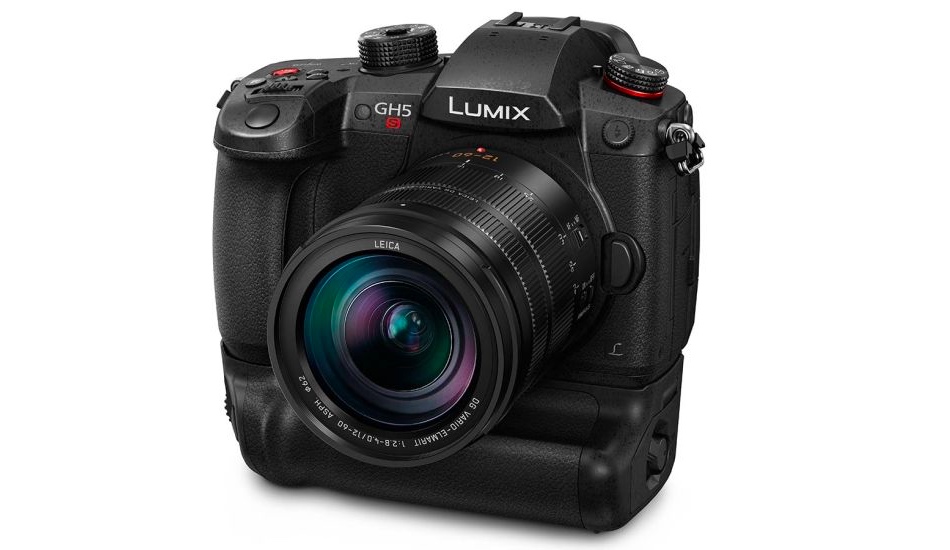
Panasonic unveils its LUMIX GH5S mirrorless camera


Panasonic has showcased its latest LUMIX GH5S mirrorless camera at the Consumer Electronics Show 2018, Las Vegas. The camera is specially designed for the professional photographers and filmmakers, at a price tag of $2,500 (roughly Rs 1,59,362) the GH5S will ship in February.
In comparison to the previous LUMIX GH5, the GH5S is $500 (approximately Rs 31,872) costlier and comes with the 10.2-megapixel sensor, which is half of the previous generation. To improve the low-light quality of the pictures by increasing the ISO to 51,200, without even having to extend the range.
Meanwhile, comparing to DSLR cameras, the mirrorless cameras are simpler, smaller, lighter and quieter because they do not have a movable mirror, a mirror housing, or a viewing pentaprism. In other words, DSLRs use a mirror-box unit to reflect the picture to an optical viewfinder or digital display, while the mirrorless uses a digital display and does not have an optical viewfinder.


Other than this, it allows capturing 14-bit raw still, which was earlier only limited to 12-bit. The GH5S comes with the new Dual Native ISO technology, that can be used from ISO 400 to ISO 2,500 to capture accurate and low-light noise.

As far as Video recording is concerned, the GH5S captures Cinema 4K at 30 fps and 60fps, along with the 10-bit 4:2:2 internal recording in 30fps and 4:2:0 8-bit in 60fps, which the Panasonic claims to be the first for a mirrorless camera. Further, in multi-aspect ratio one can shoot view angle across the 4:3, 17:9, 16:9, and 3:2 formats.
The camera features a splash-proof, dustproof, and even freezeproof (down to –10 degree Celsius) design. As far as connectivity is concerned, it is equipped with the dual UHS-II SD memory card slots, USB 3.1 Type-C, Wi-Fi and Bluetooth 4.2. It has a 3.2-inch display with 1.62-million-dot, 120fps free-angle touchscreen.

Wednesday, 10 January 2018

Samsung to launch foldable phone in 2019 BHARATKUMAR BHAGAT 2018-01-11 06:18:20 8 views As of now, the specifications of the foldable phone is not known but the device is expected to feature a 7.3-inch flexible OLED display, folding which will make it a smartphone. Last year in September, Samsung’s Mobile Chief DJ Koh said that the company will be launching a foldable smartphone sometime in 2018. But now contrary to that, Koh has now revealed at the ongoing CES event in Las Vegas, that the launch time frame has been pushed to 2019. As per Koh, Samsung will be launching its first foldable phone in 2018 only if it is able to fix the technical problems that they are facing with the first foldable phone. At the CES event, he said that UX is the major problem with its first foldable smartphone and the company has been actively working to resolve this problem. Meanwhile, a report by ET News reported Samsung will start mass-production of foldable smartphones in November. The report further adds that the company is planning to start the design work from March and manufacture panels in September. As of now, the specifications of the foldable phone is not known but the device is expected to feature a 7.3-inch flexible OLED display, folding which will make it a smartphone. By unfolding the device, users can use it like a tablet. The flexible smartphone can be considered as the next wave of revolution in the smartphone industry. Although, there is no official word about this development, it would be interesting to see the upcoming foldable smartphone from Samsung's arsenal.


As of now, the specifications of the foldable phone is not known but the device is expected to feature a 7.3-inch flexible OLED display, folding which will make it a smartphone.


Last year in September, Samsung’s Mobile Chief DJ Koh said that the company will be launching a foldable smartphone sometime in 2018. But now contrary to that, Koh has now revealed at the ongoing CES event in Las Vegas, that the launch time frame has been pushed to 2019.

As per Koh, Samsung will be launching its first foldable phone in 2018 only if it is able to fix the technical problems that they are facing with the first foldable phone. At the CES event, he said that UX is the major problem with its first foldable smartphone and the company has been actively working to resolve this problem.

Meanwhile, a report by ET News reported Samsung will start mass-production of foldable smartphones in November. The report further adds that the company is planning to start the design work from March and manufacture panels in September.

As of now, the specifications of the foldable phone is not known but the device is expected to feature a 7.3-inch flexible OLED display, folding which will make it a smartphone. By unfolding the device, users can use it like a tablet. The flexible smartphone can be considered as the next wave of revolution in the smartphone industry. Although, there is no official word about this development, it would be interesting to see the upcoming foldable smartphone from Samsung's arsenal.


Last year in September, Samsung’s Mobile Chief DJ Koh said that the company will be launching a foldable smartphone sometime in 2018. But now contrary to that, Koh has now revealed at the ongoing CES event in Las Vegas, that the launch time frame has been pushed to 2019.

As per Koh, Samsung will be launching its first foldable phone in 2018 only if it is able to fix the technical problems that they are facing with the first foldable phone. At the CES event, he said that UX is the major problem with its first foldable smartphone and the company has been actively working to resolve this problem.

Meanwhile, a report by ET News reported Samsung will start mass-production of foldable smartphones in November. The report further adds that the company is planning to start the design work from March and manufacture panels in September.

As of now, the specifications of the foldable phone is not known but the device is expected to feature a 7.3-inch flexible OLED display, folding which will make it a smartphone. By unfolding the device, users can use it like a tablet. The flexible smartphone can be considered as the next wave of revolution in the smartphone industry. Although, there is no official word about this development, it would be interesting to see the upcoming foldable smartphone from Samsung's arsenal.

Tuesday, 9 January 2018

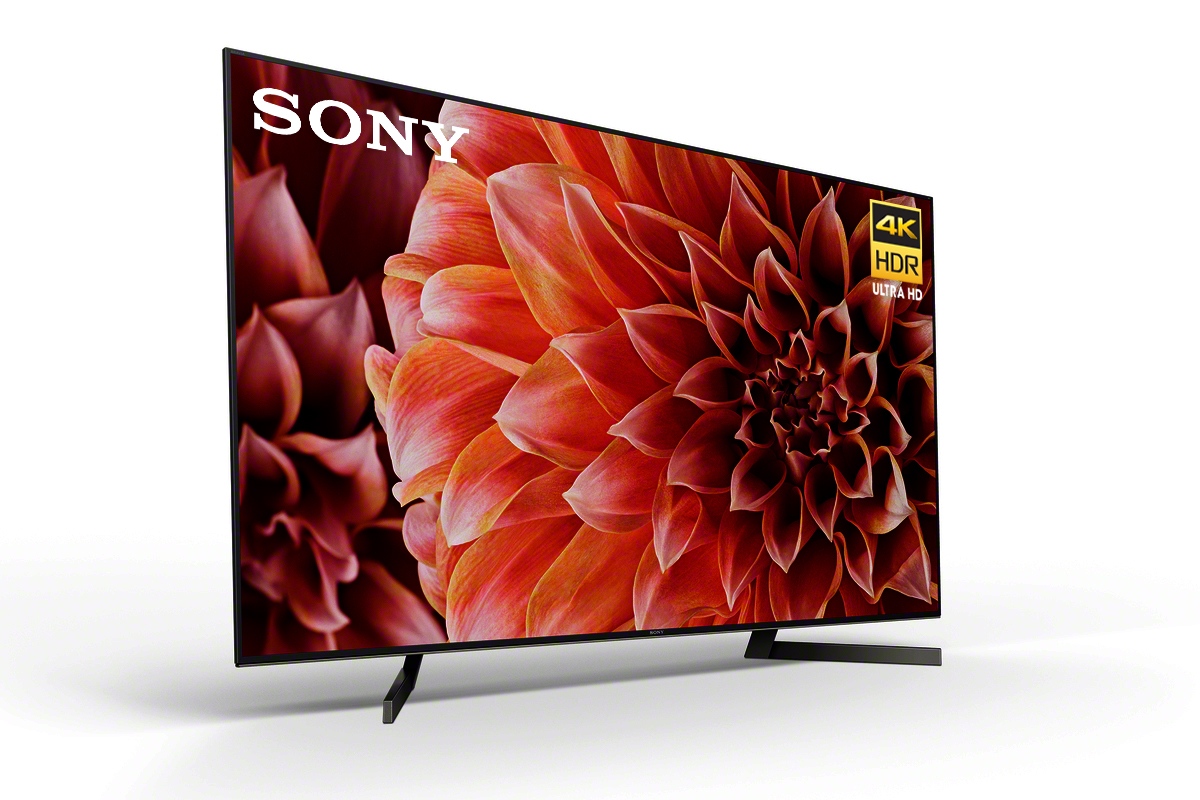
Sony expands X900F and A8F series TVs with new 4K HDR models

All models in Sony’s X900F and A8F series run Android with Google Assistant baked in”

At CES this year, tech-giant Sony added a slew of new 4K HDR models to its X900F line of LED TVs and A8F line of OLED sets. The TVs in their respective lineups boast similar features, albeit come in varying screen sizes.
Coming to the X900F rangeof 4K HDR LED TVs first, Sony is offering the series in 85-inch, 75-inch, 65-inch, 55-inch and 49-inch screen sizes. As we mentioned previously, all the models in the X900F series boast 4K HDR panelsand work alongside Sony’s X1 Extreme processor to produce vivid and beautiful images. The panels also feature X-tended Dynamic Range PRO 6x, which enhances the HDR content by boosting and dimming the backlight levels precisely for each zone on the screen. Further, Sony has also bundled X-Motion Clarity with the X900F series of LED TVs, which significantly reduces the blur while watching fast-paced sequences.


Lastly, all models in Sony’s X900F series run Android with Google Assistant baked in. Sony’s Android TVs also work with Amazon-Alexa-enabled devices and Google Home, giving usershands-free control over their TV sets.

As far as the A8F series of 4K OLED TVsis concerned, Sony has added two models of 65-inch and 55-inch screen sizes to the lineup. The TVs boast 8million self-illuminating OLED pixels whichproduce significantly darker blacks and offer a wide viewing angle. As we saw previously with the Bravia A1 OLED TV, the newer models also feature Sony’s Acoustic Surface Technology which resonates the entire screen, with sound being produced directly from the display panelitself.
Much like the X900F series, the A8F series is also backed by Sony’s X1 Extreme processor and boots Android OS with Google Assistant baked in.These TVs are also compatible with Amazon Alexa and Google Home. Sony is yet to reveal the pricing and availability details of these TVs, so stay tuned to our blog for more updates on the same

Monday, 8 January 2018

[Acerupdate] [info] Acer unveils its Swift 7, Spin 3, Nitro 5 and Chromebook

The Acer Swift 7 is just 8.89 mm thin which makes it the world’s thinnest laptop


Acer has announced the launch of its four new laptops at the CES 2018. The company has unveiled its world’s thinnest notebook, Swift 7; a convertible laptop, Acer Spin 3; Acer Nitro 5 and Acer Chromebook 11. The Acer Swift 7 will be launched in March at $1,699 (Rs 1,07,776 approx), while the Acer Spin 3 will sell for $599 (Rs 37,999 approx) starting from this month. The Nitro 5 and Chromebook 11 will be available for $799 (Rs 50,500 approx) and $249 (Rs 15,800) respectively.
The major highlight of the Acer Swift 7, is its thickness. The device is only 8.89 mm thin which makes it the world’s thinnest laptop. The notebook is specially designed for mobility, the company claims to offer 10 hours of battery life and 4G LTE connectivity via Nano-SIM card.


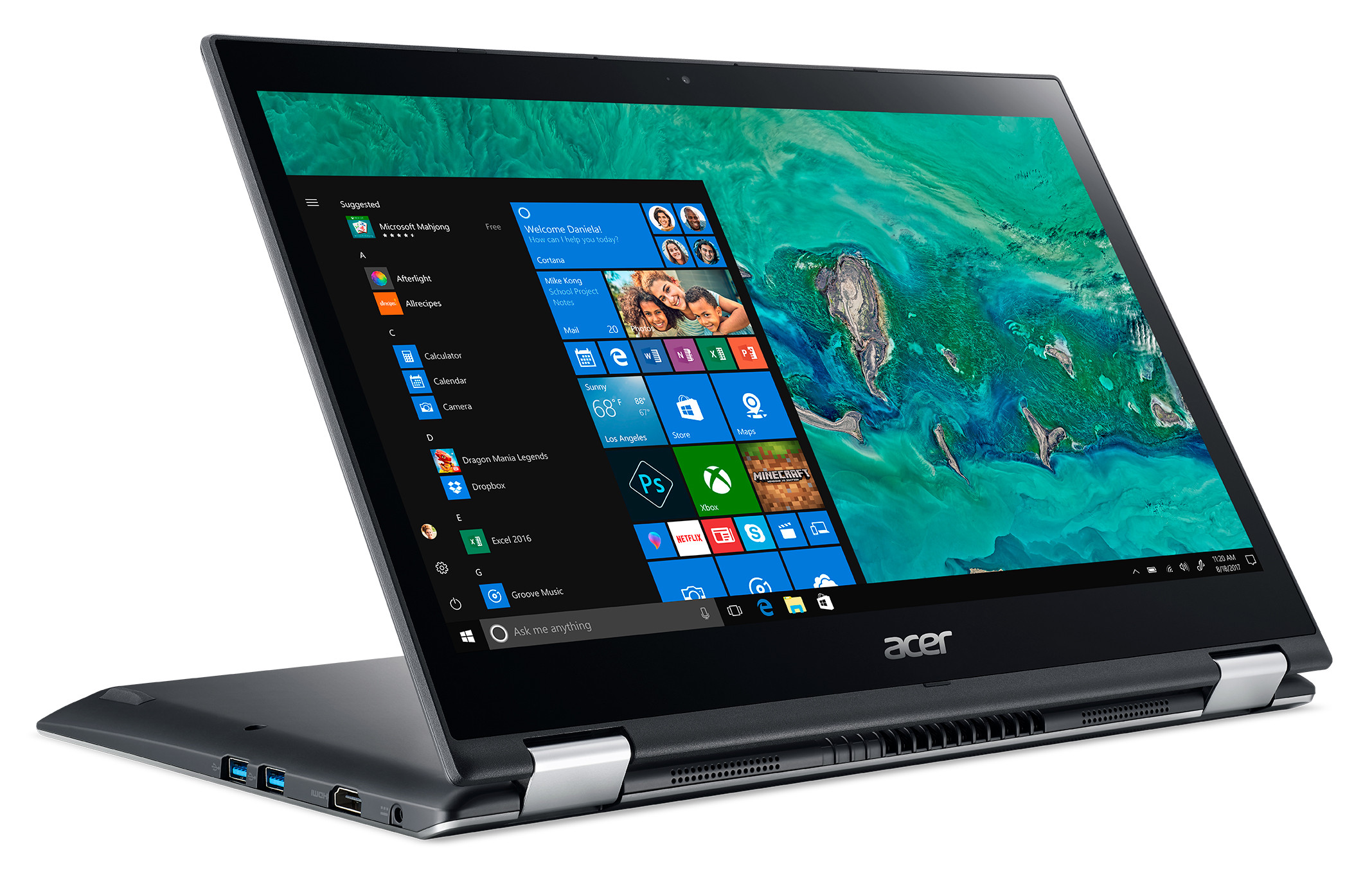
Acer Spin 3
The Swift 7 ships with a Transatel profile provisioned with up to 1 GB of free data valid for one month in 48 countries to help users get started immediately, while additional data plans can be easily purchased as needed through the Mobile Plans application while travelling around the world.
As far as specifications are concerned, the Swift 7 spots a 14-inch Full HD IPS touch display with the resolution of 1920x1080 pixels, which is protected by the Corning Gorilla Glass. The laptop is powered by a 7th Gen Intel Core i7 processor and runs on Windows 10 operating system. It is backed up by 8GB LPDDR3 RAM and 256GB of SSD storage.

Moving to the Acer Spin 3, the features a 14-inch Full HD display(1920x1080 pixels) with IPS technology. It is equipped with the 8th Gen Intel Core i5 processor and comes with the 8GB of DDR4 RAM and 1TB hard drive/ 128GB SSD of storage. The device runs on Windows 10 operating system and offers 4605 mAh Li-ion battery, which the company claims delivers up to 12 hours of battery backup. The Acer Nitro 5 has a 15.6-inch Full HD IPS touch display. The device is powered by the lRyzen mobile processor with Radeon TX560 graphics. It is backed by up to 32GB of RAM, and coupled up to 512GB SATA SSD.

The Acer Chromebook 11 has an 11.6-inch display with the resolution of 1366x768 pixels. It is equipped with Intel Celeron processors and 4GB of RAM + 16GB/32GB eMMC storage. Further, the Chromebook comes with HDR camera, Dual stereo speakers, and an integrated microphone. Similar to the Acer Swift 7, the company claims to features 10 hours of battery life and only weighs 1.1 kg. As far as connectivity is concerned, it has two USB 3.1 Type-C Gen 1 ports and two USB 3.0 Type-A ports, other than this it comes with Bluetooth 4.2 and WiFi 802.11ac 2x2 MIMO.